
Health Equity and the IRB
As part of an effort to prioritize health equity in Los Angeles County, the Department of Public Health Institutional Review Board (IRB) implemented the Health Equity Initiative (HEI). Through this initiative, the IRB is working to ensure that principles of health equity such as community engagement and cultural and linguistic inclusion are incorporated into the research, evaluation, and other data-gathering activities that are conducted by the Department and community partners. The HEI is described in more detail below.
HEALTH EQUITY INITIATIVE SUMMARY
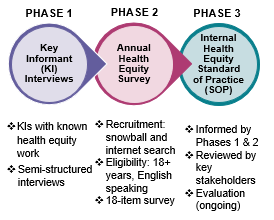
CURRENT EFFORTS
IRB staff recently presented at the monthly Equity Technical Assistance Office Hours meeting hosted by the CA Dept. of Public Health's Equity team for local health jurisdictions.
To view a copy of the presentation slides, click here: Equity TA
HEI Phase 3 (Current)
Informed by data from Phases 1 and 2 (see "Reports” section below for more details), IRB staff developed an internal Health Equity Standard of Practice (SOP) that aims to:
1) serve as a roadmap for DPH investigators to integrate principles of health equity in their projects; and
2) ensure accountability in the ongoing process of addressing health equity in research by integrating the collection of health equity measures into the DPH IRB review process.
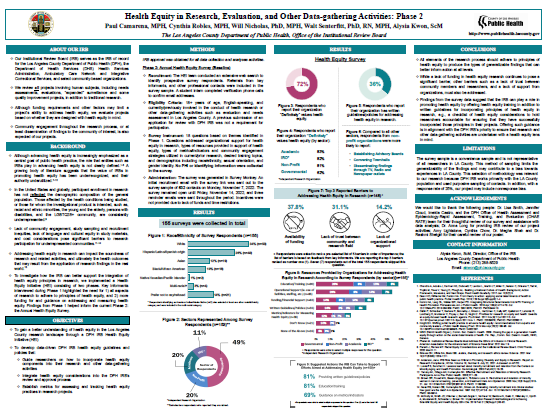
In an effort to evaluate the impact of our SOP, a health equity evaluation survey has been collected from IRB applicants before and after the dissemination of the SOP. Post-dissemination data are still being collected. Please see our baseline evaluation report below for a summary of our pre-dissemination data.
In addition, we have adapted our internal Health Equity SOP for use by our community-based and other non-DPH partners.
To view a copy of the external policy, please click here: Health Equity Policy.
REPORTS
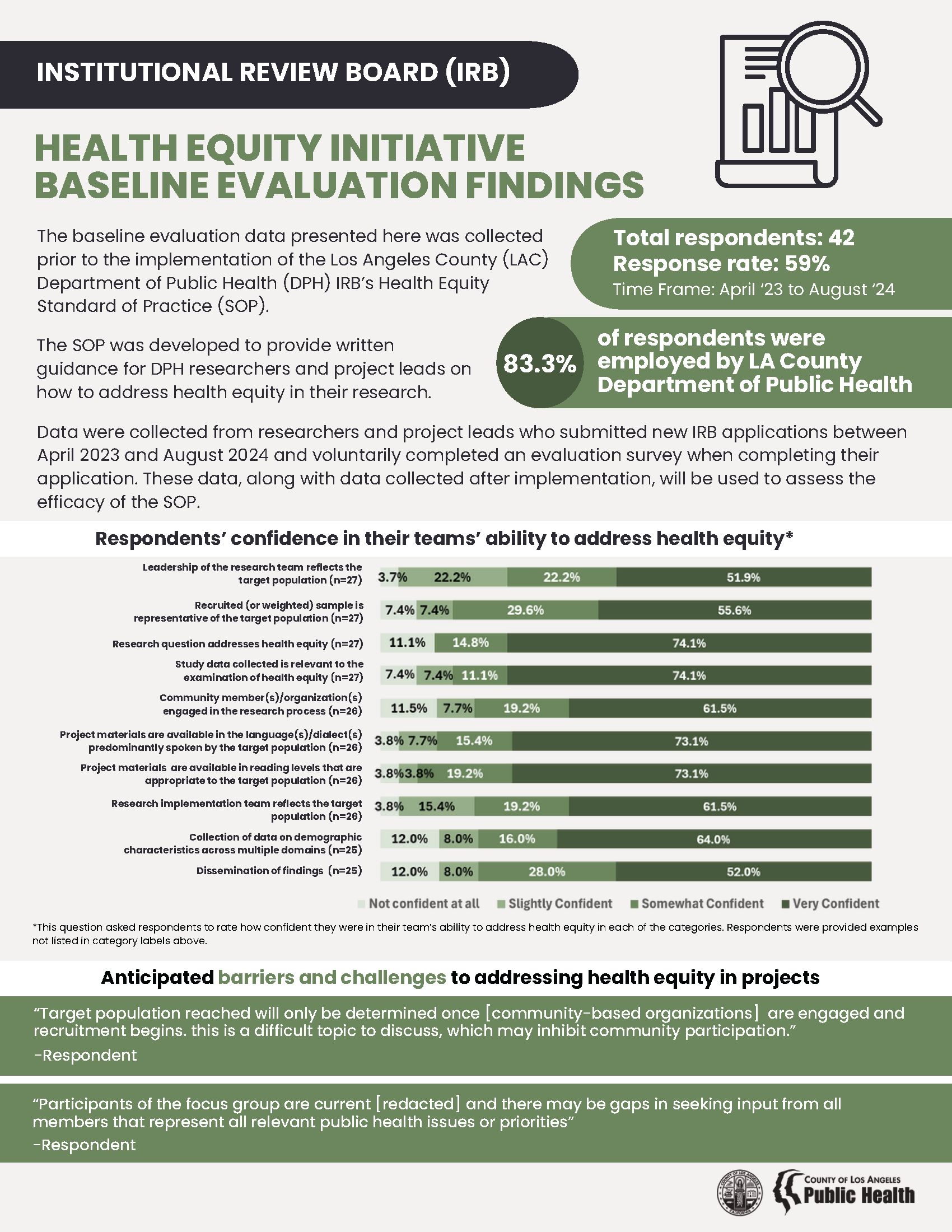
Click on the image to view a summary of the baseline evaluation data collected prior to the dissemination of our Health Equity SOP.
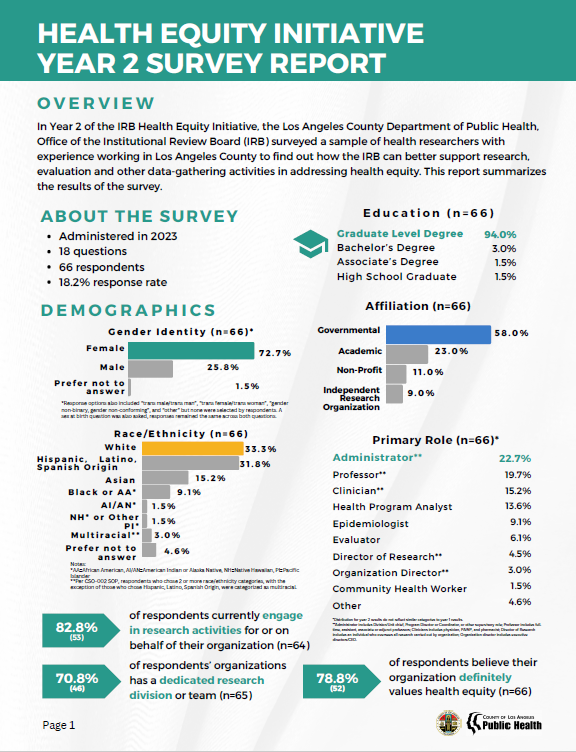
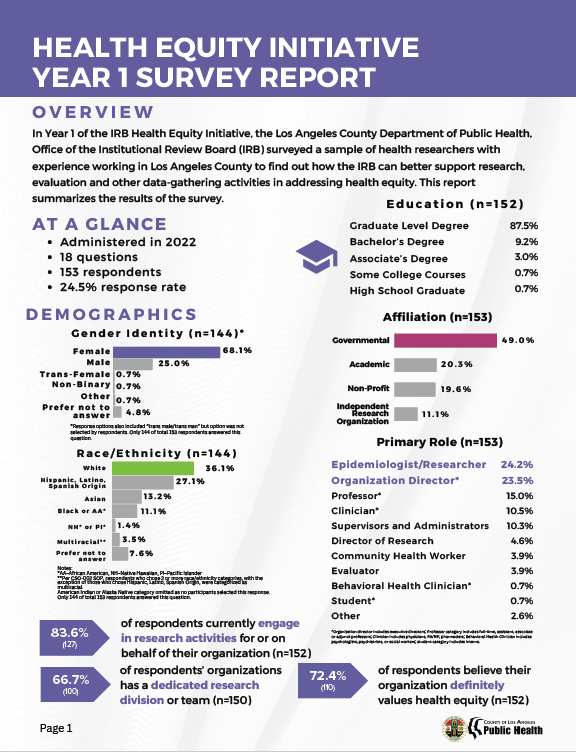
Click on the image to view a summary of results from our Year 1 HEI survey.
Click on the image to view the full report that describes Phase 1 of the HEI.
Key Takeaways from HEI Phase 1 Interviews
- The research field must do a better job of engaging underserved communities throughout all aspects of the health research process, from the conception and design of a study to the analysis and dissemination of results.
- Taking a community-based approach to health research can improve the engagement and investment of the community leading to a more equitable research process and data that is more representative of and relevant to the target communities.
- Organizations that engage in health research should provide resources such as operational support (i.e., use of facilities or other infrastructure, personnel, etc.), adequate training, and funding to integrate a more equitable and community-based approach to their research activities.
- Organizations that fund health research should incorporate health equity standards in their grant awards so that grantees can be held accountable for addressing issues of health equity in their research. Funders should also re-assess the size of their awards to ensure that grantees have sufficient funding for activities such as evaluation, translation of study documents, implementing more equitable recruitment campaigns, providing more equitable study incentives, etc.
POSTERS
Resources
Visit the Center for Health Equity website for more information about the Los Angeles County Department of Public Health's ongoing efforts to address health equity.
To view a copy of Health Equity Standard of Practice (SOP), please click here: Health Equity Policy